
Posted by Peter Orr on Fri, Feb 19, 2010 @ 11:24 AM
"Prediction is very difficult, especially if it's about the future."
- Niels Bohr (long before Yogi Berra)
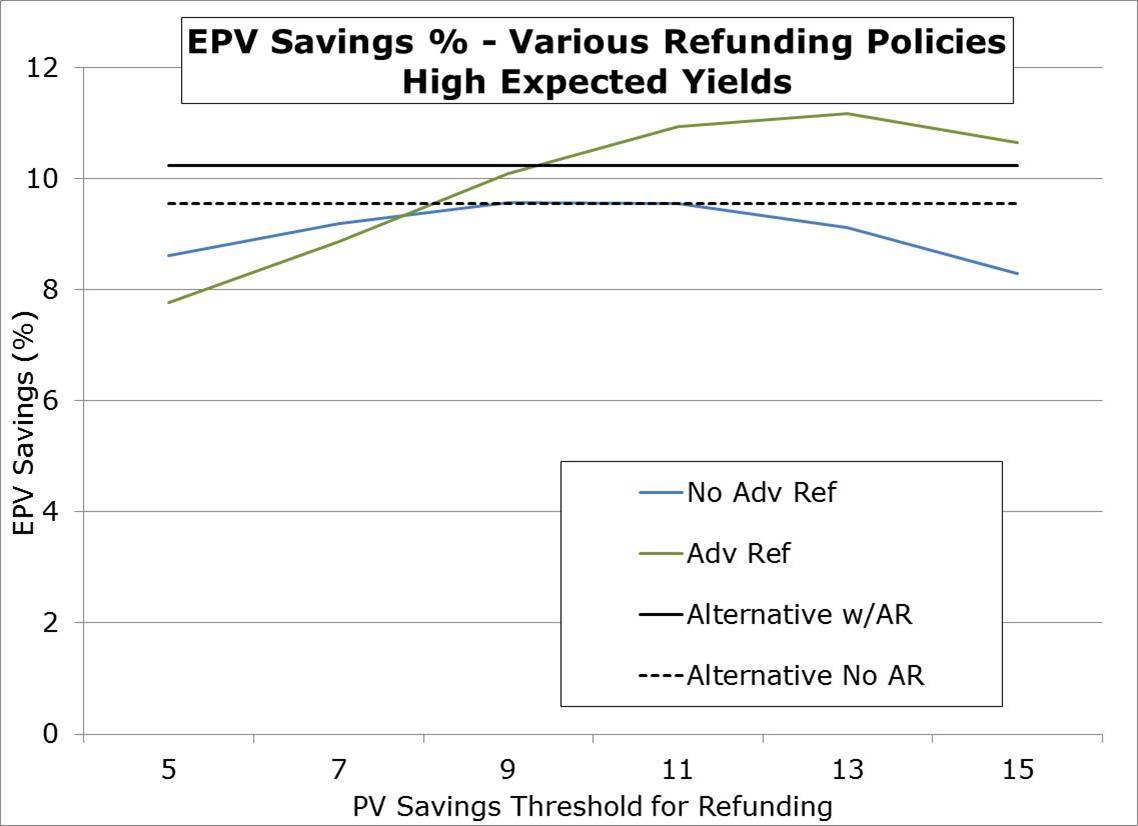
Lots of people seem to be making a big mistake analyzing Build America Bonds (BABs). The popular and straightforward analysis is to compare yields on traditional fixed rate bonds (or "BOBs" as I call them - Boring Old Bonds) to the after-subsidy yield on BABs. Here's an example:

The (overly) simple analysis says that BOBs are the cheaper cost of capital through about year 12 and then BABs are the way to go thereafter.
The heroic simplifying assumption of course that works so nicely in spreadsheets and standard software packages is that this line-item Federal subsidy duck will stay staticand not shot down over the entire life of the bonds. Is this a good assumption? Let's look at some facts:
- The BABs legislation explicitly states that the subsidy is not permanent and can be changed at any time
- The BABs subsidy is qualitatively very different than the one inherent in BOBs. As anyone dealing with a government budget knows, there's a fundamental practical and political difference between revenue lost in the opportunity sense (BOBs) vs the Treasury needing to cut a check for a subsidy as with BABs
- The US debt and fiscal imbalance are ugly. Some argue worse than they've been excluding WWII
With these facts, is it prudent to be overly optimistic about this US subsidy staying static over 20-30 years, through changing administrations, congressional seats and political winds? I don't think so. In fact, the analysis of this risk is not unlike the oft-discussed "tax risk" that people cogitated about when evaluating synthetic fixed-rate borrowing strategies using LIBOR swaps.
Putting a finer point on it, when an issuer sells BOBs the following risks are shifted to the investor:
1) Interest rate - rates go through the moon, the investor suffers the MTM loss. The nominal cost of capital for the issuer is locked in.
2) Credit - should the issuer's credit deteriorate, again the investor suffers
3) Tax law - should the US become less reliant on income taxes and more on consumption taxes or VAT or shifts to a flat tax, the preference for tax-exempt income would fall and investors would suffer losses.
For BABs, the third item no longer applies. The investor gets a taxable coupon. Has the third risk gone away entirely? I think it's been transformed. That third "tax law" risk is now replaced with US Fiscal Policy Risk (FP RiskTM) which I would argue is significantly non-zero and different qualitatively then we've seen before in the tax-exempt markets.
So if we're NOT to assume that this subsidy will stay static, and now the issuer has this new FP Risk to manage, how can this risk be incorporated into decision-metrics in a non-trivial way? After all, what gets measured gets managed. Stay tuned, but in the meantime, what do
youthink?
Posted by Peter Orr on Sun, Oct 25, 2009 @ 04:22 PM
"It is better to understand a little, than to misunderstand a lot."
- Unknown
The prior two posts came to one simple conclusion: most tax-exempt issuers who have used LIBOR based swaps to hedge variable bonds are over-hedged (see prior posts for details why). This conclusion has two primary ramifications:
- If you hedged with, for example, 15% more swap than necessary than the issuer paid 15% more to the swap dealer than necessary. Across an estimated $1.5 billion+ in compensation to swap dealers over the last several years on these, its real dough
- In high rate environments, the overall cost of funding will be lower than expected and in low rate environments higher
Let's look at a simple example. AnyCity, USA uses a 3.50% $100 million 68% 1M LIBOR to hedge $100 million in tax-exempt variable rate demand bonds (VRDBs). This 68% number was determined using an historic average and an implicit assumption of zero correlation between 1M LIBOR and SIFMA/1M LIBOR ratios. If one had assumed correlation of -.35, which is more consistent with what we've seen and might reasonably expect, then the right hedging index would be 58% LIBOR plus 0.52%. Both of these swaps carry a fixed rate of 3.5%.
When rates are low, the floating leg of the swap at 68% of 1M LIBOR is less than the 58% of LIBOR plus 52bps. On our $100 million swap for AnyCity, the graph of LIBOR rate level versus annual benefit to having the 58%+52 basis point leg looks like this:

Now obviously as rates go higher the benefit becomes a loss, but that's the point: this is no longer a hedged position as there's an inherent interest rate view within the structure. The overall synthetic fixed-rate structure (variable rate bonds swapped to fixed) performs worse than expected in low rate environments but better than expected in high rate environments. This is due to the fact that we expect SIFMA/LIBOR ratios to be somewhat higher on average in low rate environments and vice versa (the negative correlation between rates and ratios). What does this all mean? Well, few issuers are entering into new synthetic fixed rate deals so it matters more for those that are doing restructuring. What is the optimal portfolio-wide level of LIBOR based swaps for hedging tax-exempt variable rates? Probably less than one might think. What's an issuer to do? Well, if you have more swaps than you need than you could unwind some swaps now though in this rate environment they're likely under water. You could wait for rates to rise and unwind when the swaps are closer to a zero mark or even an asset. Have to be careful though...that'd be speculating.